One indicator OHA uses to measure change over time at our restoration sites is the migratory songbird population, using a timed point-count method.
We conduct a point-count bird survey at our Myers Creek mitigation site near Chesaw for one morning in late May or early June. We visit several stations and record which bird species we observe at each — near and far, during two different timeframes. Some interesting species we have seen in past years include the Black-headed Grosbeak, Gray Catbird, Eastern Kingbird, and Clay-colored Sparrow, among many others.
Pre-registration is required, and event details are provided to those who sign up. The survey route covers just under two miles of very uneven terrain with some sidehill hiking and no established trail; please ensure that this kind of activity suits your fitness level and stamina if you wish to participate. There are no restroom facilities onsite, but there is an outdoor toilet available in the town of Chesaw (bring your own TP).
If you bird by ear and/or sight and would like to share your skills, please contact info@okanoganhighlands.org. Let us know if you’d like to be invited to other bird surveys in the future, and we’ll be sure you are on our email list!
See below for photos from the annual event at Myers Creek over the years. Thank you to all the volunteers who have contributed to this important effort since 2011! We hope that as the habitat improves, it will be capable of supporting an increasing diversity of bird species! In our 2019 survey, we observed 30 different species!
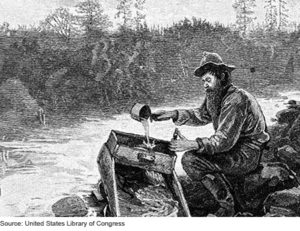
Following the boom of mineral discoveries in the west such as the California Gold Rush, the General Mining Act of 1872 was passed by President Ulysses S. Grant to promote settlement and natural resource development in the west. Despite outdated terms, such as charging claimants a “mineral patent” to mine land at no more than $5 per acre, this law continues to govern mineral exploration and extraction in the U.S. today.
SEC. 2319. All valuable mineral deposits in lands belonging to the United States, both surveyed and unsurveyed, are hereby declared to be free and open to exploration and purchase… Click here for the full text of the 1872 Mining Act
Wetlands around the world protect communities while helping fight climate change
As the world grapples with climate change, those commemorating World Wetlands Day Feb. 2 are highlighting the importance of restoring, conserving, and wisely using wetlands because they can help reduce floods, relieve droughts, and buffer coastlines from extreme weather.
In the state of Washington, we work every day to protect and manage wetlands. The environmental and economic benefits they provide nature, our communities, and way of life are immeasurable…
To help celebrate World Wetlands Day, the WA State Department of Ecology selected the Triple Creek project to feature on their blog. Click here to read the full article.
In 1980, a group of like-minded individuals purchased over 500 acres of land along Myers Creek north of Chesaw, on a site now known as Triple Creek. They formed an intentional community based on simple living and sustainable paths for securing food and shelter. Several households now live on this Okanogan Highlands landscape of forests, meadows, wetlands, and riparian areas. A primary goal of the community is improving and restoring wildlife habitat for native species. Members have developed a forest management plan, rehabilitated overgrazed pastures, and reduced noxious weeds, thus reestablishing native plants. By engaging with local non-profits and agencies for wetland restoration, the community is creating a legacy to benefit future generations…
In November 2013, OHA approved an application for reimbursement for Wauconda landowner, Lee Johnson. Lee sought reimbursement for expenses for fences to protect a unique and exceptional wetland that he recently purchased.
Having lived adjacent to the wetland for over 30 years, Lee has built and maintained a fence that protects this resource, long before he actually purchased the wetland.
The protected area includes approximately 25 acres of wetland and forest fringe, laying north of Bunch Road at 4,000 feet elevation.
There are several ways in which gold mining can affect water quality. Some of the following information is taken from the Safe Drinking Water Foundation online article, “Mining and Water Pollution.” Local photos are displayed, pertaining to Buckhorn Mountain and the associated facilities.
Introduction
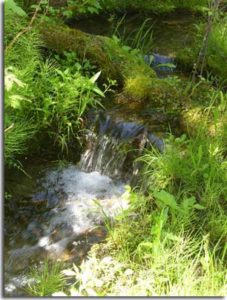
A stream feeding the Nine Acre Wetland, located near the Buckhorn mining operation
Water is essential to life on our planet. A prerequisite of sustainable development must be to ensure uncontaminated streams, rivers, lakes and oceans.
Mining affects fresh water through heavy use of water in processing ore, and through water pollution from discharged mine effluent and seepage from tailings and waste rock impoundments. Increasingly, human activities such as mining threaten the water sources on which we all depend. Water has been called “mining’s most common casualty” (James Lyon, interview, Mineral Policy Center, Washington DC). There is growing awareness of the environmental legacy of mining activities that have been undertaken with little concern for the environment. The price we have paid for our everyday use of minerals has sometimes been very high. Mining by its nature consumes, diverts and can seriously pollute water resources.
Negative Impacts
While there have been improvements to mining practices in recent years, significant environmental risks remain. Negative impacts can vary from the sedimentation caused by poorly built roads during exploration through to the sediment, and disturbance of water during mine construction. Water pollution from mine waste rock and tailings may need to be managed for decades, if not centuries, after closure. These impacts depend on a variety of factors, such as the sensitivity of local terrain, the composition of minerals being mined, the type of technology employed, the skill, knowledge and environmental commitment of the company, and finally, our ability to monitor and enforce compliance with environmental regulations. One of the problems is that mining has become more mechanized and therefore able to handle more rock and ore material than ever before. Therefore, mine waste has multiplied enormously. As mine technologies are developed to make it more profitable to mine low grade ore, even more waste will be generated in the future.
Waste from the Mining Process
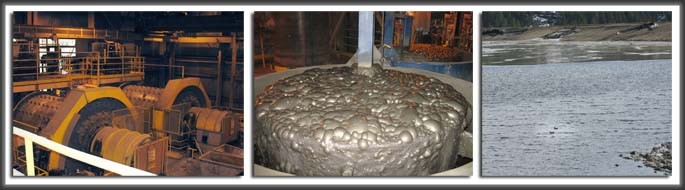
Ore is mineralized rock containing a valued metal such as gold…The ore is crushed into finely ground tailings for processing with various chemicals and separating processes to extract the final product.
Kettle River facilities
Types of Water Pollution from Mining
Acid Mine Drainage
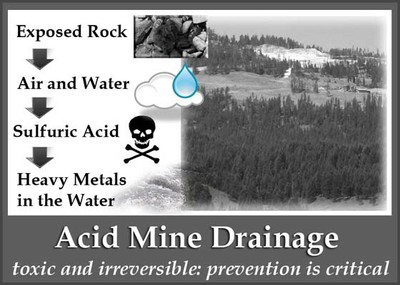
Many of the metals being mined in North America, including the gold mined from Buckhorn, tend to be found in rock that contains sulfide minerals. When ore and surrounding rock are excavated during mining, the sulfides become exposed to water and air, and may form sulfuric acid. This acid in turn leaches metals and other substances from the rocks that can harm ecosystems. The acid will leach from the rock as long as its source rock is exposed to air and water and until the sulphides are leached out – a process that can last hundreds, even thousands of years. Acid is carried off the minesite by rainwater or surface drainage and deposited into nearby streams, rivers, lakes and groundwater. Acid mine drainage is considered one of the most serious environmental threats posed by mining, and it can devastate aquatic resources for generations.
Heavy Metal Contamination & Leaching
Heavy metal pollution is caused when such metals as arsenic, cobalt, copper, cadmium, lead, silver and zinc contained in excavated rock or exposed in an underground mine come in contact with water. Metals are leached out and carried downstream as water washes over the rock surface. Although metals can become mobile in neutral pH conditions, leaching is particularly accelerated in the low pH conditions such as are created by Acid Mine Drainage.
Processing Chemicals Pollution
This kind of pollution occurs when chemical agents (such as cyanide or sulphuric acid used by mining companies to separate the target mineral from the ore) spill, leak, or leach from the mine site into nearby water bodies. These chemicals can be highly toxic to humans and wildlife.
Erosion and Sedimentation
Mineral development disturbs soil and rock in the course of constructing and maintaining roads, open pits, and waste impoundments. In the absence of adequate prevention and control strategies, erosion of the exposed earth may carry substantial amounts of sediment into streams, rivers and lakes. Excessive sediment can clog riverbeds and smother watershed vegetation, wildlife habitat and aquatic organisms.
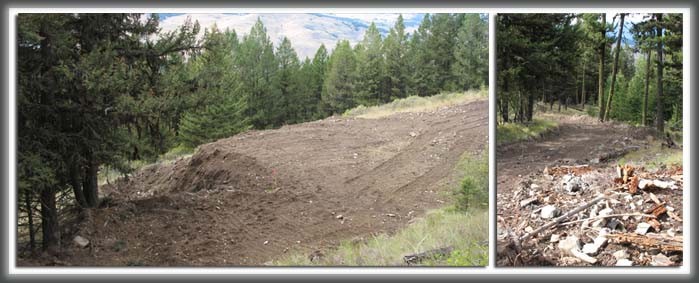
Drillpad exploration
Water Quantity
Mining can deplete surface and groundwater supplies. Groundwater withdrawals may damage or destroy streamside habitat many miles from the actual mine site. [end quote from the Mining and Water Pollution article]
Each spring since 2016, students from the Tonasket Outreach Program have been invited to participate in Triple Creek restoration project. During the first field trip, a group of 23 students of all ages, and six adult volunteers came out to the site and helped with planting trees and shrubs, building perches for birds of prey, taking photos to monitor the site, and participating in educational activities that illustrated the connections between producers and consumers in the web of life.
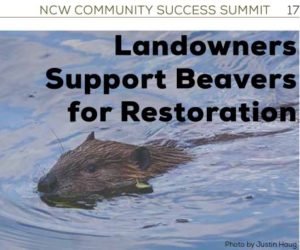
Participation at Triple Creek offers a bounty of ongoing learning experiences for the students of Outreach. Their classroom teacher, Sonja, has been leading students in research on riparian buffer zones. Grades 3-6 have been learning about photo monitoring, and helping to organize documentation of the project. They have also been able to celebrate the return of beaver to the creek! There will be a variety of opportunities for students of all ages to be involved throughout the school year, culminating in a return field trip in the spring. At that time students observe major changes that have occurred in the stream since their previous visit. They will see the instream structures that OHA and our team have constructed, and the ways in which these structures have mimicked beaver dams.
In 2019, the Outreach students are merging music and science with OHA’s Conservation Coordinator, Julie Vanderwal, as they compose a song to tell the story of change at Triple Creek. Later this spring, Outreach took another field trip to the project site to observe its improvement and to help plant more willow saplings in the riparian buffer zone around the streams. OHA appreciates all the work the Outreach teachers have done to coordinate these valuable experiences for the students, and the many volunteers who make the field trips possible.
This exposure offers valuable insight into multiple facets of science and study. They have been introduced to various fields and disciplines that can inspire and expand their opportunities for the future, including wildlife biology, watershed ecology, botany, geology, and field studies. They are learning about data collection and analysis, record keeping, wildlife photography, and the scientific method of observation. By maintaining connectivity throughout this process we are encouraging an ongoing relationship with these local ecosystems that will last beyond the memory of a single field trip, and encourage stewardship in our future generations.