Water Quality
Degradation of water is NOT in the public interest
The Washington Department of Ecology issued a Water Quality Certification to Crown Resources/Kinross mine under section 401 of the federal Clean Water Act. In so doing it declares that it has reasonable assurance that water quality resulting from the mine will meet standards.
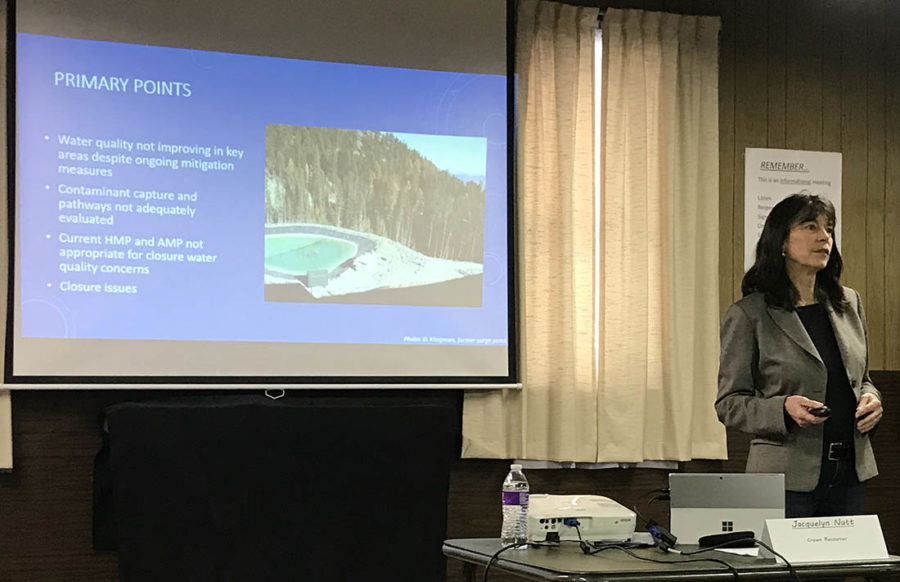
The reporting and analysis of monitoring data is key to preventing problems from developing at the Buckhorn Mine. It is important that problems are identified early so solutions can be developed before larger adverse effects occur. After reviewing the memos and reports, in cooperation with Kinross, OHA finds the 2008 annual reporting incomplete and lacking basic foundational data needed to analyze the mine’s impacts or the accuracy of model predictions.
This mine has extensive monitoring requirements to ensure protection of the environment, but unless some fundamental changes are made to compel compliance and coordinate the discussion of results and analysis, the effectiveness will be limited.
Examples
Some general and specific examples of issues related to annual reporting requirements are as follows:
- The annual monitoring reports are poorly organized and difficult to follow. To review any aspect of the Buckhorn Mine annual reports requires navigation and cross referencing through multiple plans, reports and memos.
- NO required Hydrologic Monitor Plan (HMP) report(s) were submitted to the agencies. The plan is very specific as to the method, location, frequency, and reporting period for each aspect of the plan being monitored. While the Adaptive Management Plan (AMP) uses monitoring information to compare and evaluate, the specific requirements of the HMP have a much broader scope, and many of the required elements have not been reported. If Kinross thought that the HMP reporting requirements were contained in the AMP, some attempt should be made to document which specific requirement was being addressed. OHA did extensive cross-referencing and found many missing HMP elements. (See Stratus Consulting, 2009, Annual Reporting Requirements)
- There are many missing analyses and data. The AMP reporting contains quite a bit of very useful information that has been greatly improved since the annual coordination meeting with the addition of a table of contents for the ten memos that Golder provided when OHA asked for it. However, much of the data analysis and interpretation required annually has not been reported. . For example:
- The discharge to the NPDES outfalls was not reported.
- The AMP requires comparison of operational data with pre-mining predictions and conditions, but many of the comparisons were not conducted or only partially conducted.
- The on-site meteorological station did not function for most of 2008. The failure of Kinross to maintain a functioning weather station on Buckhorn Mountain makes problematic the evaluation of whether water resource impacts are mine or weather related. Kinross made an effort to provide alternative data, but given the very localized weather patterns for the area, meteorological information must be site-specific (i.e. on Buckhorn Mountain) to be representative.
It is not enough to simply say we will do better next time. We need to reevaluate ground and surface water predictions and make improvements as part of adaptive management for the mine.