You are here: Home The Issues Water Quality
Document Actions

Water Quality

Degradation of water is NOT in the public interest

Current Water Quality Issues:


• Certain constituents are increasing, but not to harmful levels; trends should be watched

• Surface water, groundwater, seeps: –Increasing nitrate, chloride, sulfate, TDS and/or decreasing pH –Some locations with increasing metal/ metalloid concentrations 

• Stormwater: elevated pH, chloride, metals 

• Mine water: high nitrate, ammonia, chloride, sulfate, TDS, pH (over 10), fluoride, hardness, oil and grease 

• Difficult to distinguish between effects of treated discharge vs. transport from underground mine


Development Rock

• Too much Potentially Acid Generating (PAG) rock; 37% more than predicted in southwest zone (not into the Gold Bowl yet where there is considerably more)
• Need to look at potential to generate poor water quality from non-PAG rock
• If Kinross wants to use the less stringent Net Acid Generating test, they need to correlate with results from the “standard” Acid Based Accounting testing.


Water Treatment Plant (WTP)

• WY 2009 Violations: –Arsenic (December, January, April); TDS (May); ammonia (June); zinc (July); chlorine (July) 

• Removal improvements at end of 2009:

–Ion exchange combined with reverse osmosis

–Sulfate, TDS, nitrate and nitrite, chloride • Remaining Issues

–Hardness and alkalinity too low for protection of aquatic biota in surface water discharges (metals toxicity increases with lower hardness/ alkalinity)

–Ammonia still elevated; sodium not monitored

Recommendations:

• Add in calcium/hardness/alkalinity 

• Analyze effluent for sodium


Recent Operational Improvements: The storage of large amounts of water in the mine that occurred in unlined sumps in spring 2010 and 2011, and the larger than predicted quantity of potentially acid generating (PAG) rock stored on the surface, are likely exacerbating the water quality problems. The new larger Reverse Osmosis unit (see photo below) should alleviate the problems caused by large quantities of water stored in mine sumps. Additionally, the future use of PAG rock as cemented backfill, when properly sealed, should start to alleviate the problems caused by large amounts of PAG rock stored on the surface.

Water Treatment Plant (2)


Capture Zone

• Drawdown values for wells inconsistent with contours of drawdown • Unclear that seasonal fluctuations were considered 

• No Reliable Hydrologic Control; contaminants escape from underground mine • Wells/seeps downgradient of mine exhibit increasing concentrations of Water Treatment Plant related contaminants –Cannot discern effects from effluent discharge vs. groundwater leaks from treated water stored in mine

Recommendations:

• Improve method used to distinguish between pumping-related drawdown and seasonal fluctuations

• Evaluate hydrologic pathways from mine to locations with increased mine- related contaminants

• Continue to monitor actual drawdown from new pumping wells 

• Design contingency if hydrologic control not improved

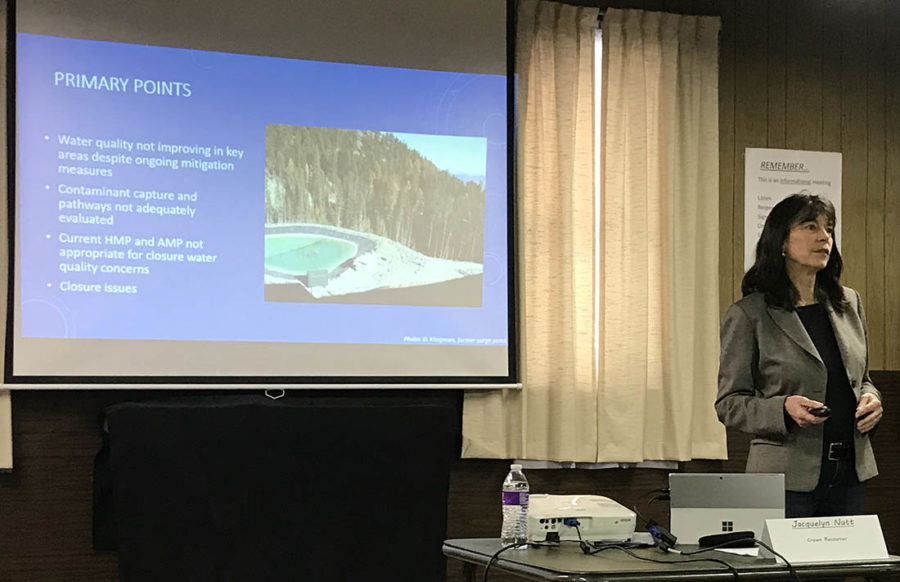
Kettle River Tailings Facility

• Surface water monitoring in NF Sandpoil River– nitrate, sulfate, TDS higher downstream than upstream of facility, generally increasing over time (see TDS graph above) • Groundwater exceedences for sulfate and nitrate in TP-3 (deeper aquifer) 

• Mean WAD cyanide concentrations in tailings water ranging from ~7 to 30 mg/L; adaptive management measures required 

• There is a trend of increasing concentrations of nitrate, sulfate, and TDS in surface water; should require Adaptive Management Plan action. 

• No detectable cyanide in underdrain water 


Ongoing Water Quality Issues:


Overview

The Washington Department of Ecology issued a Water Quality Certification to Crown Resources/Kinross mine under section 401 of the federal Clean Water Act. In so doing it declares that it has reasonable assurance that water quality resulting from the mine will meet standards. 

The reporting and analysis of monitoring data is key to preventing problems from developing at the Buckhorn Mine. It is important that problems are identified early so solutions can be developed before larger adverse effects occur. After reviewing the memos and reports, in cooperation with Kinross, OHA finds the 2008 annual reporting incomplete and lacking basic foundational data needed to analyze the mine’s impacts or the accuracy of model predictions.

This mine has extensive monitoring requirements to ensure protection of the environment, but unless some fundamental changes are made to compel compliance and coordinate the discussion of results and analysis, the effectiveness will be limited.


History of Water Quality Issues


Overall OHA expressed concern that predictions of operational and post-closure water quality were too optimistic, due in large part to underestimation of contaminant concentrations from geochemical testing results. The amount of rock predicted to become acidic over short and longer time frames were also underestimated, and plans for management and identification of acid-generating rock poorly defined. (Please see page 5 of Buckhorn Bulletin, March 2008, Vol. 2 No. 12)

• The geochemical tests used to define potentially acid-generating (PAG) rock will underestimate the acid-generation potential of rocks in the development rock stockpile and in the underground mine.

•The short test length and high detection limits for metals renders most of the humidity cell test results almost useless as indicators of water quality.

•The prediction that development rock will not become acidic in the time that it is exposed during mining is not supported by the mineralogic information or the HCT data.

•Predictions of operational and post-closure water quality underestimate the ability of the mined materials to generate acid and leach contaminants because they rely upon a series of assumptions and analytical and modeling approaches that underestimate the reactivity of mined materials.

•Predictions of mitigated post-closure mine water quality does not consider the presence of reactive mine wall rock and underestimate the exceedences of groundwater standards in the underground mine

•The use of “passivation” techniques is experimental, requires a high degree of engineering success, and is highly unlikely to prevent groundwater exceedences in the underground mine under post-closure conditions.

•The quantitation limit (QL) for effluent parameters is not defined in the NPDES permit. If the QL is not at least three to five times lower than the effluent limit, it will not be possible to distinguish a non-detect value from an exceedence.

•No specific quality assurance/quality control (QA/QC) criteria are required for sample reporting.

•No maximum daily limits are set for surface water discharges for a number of important parameters.

•The effluent limits for several of the contaminants are set higher than drinking water standards.

•The effluent limits for cadmium and nickel are much higher than the federal Clean Water Act limits using the relevant aquatic life hardness-based criterion values at the hardness value suggested in the permit.

•Chronic and acute tests should be run when concentrations in the stream are the highest.

•The discharge of treated effluent to groundwater will cause exceedences of toxics in surface water.

•In addition to water quantity or flow monitoring, Myers Creek and tributaries should be monitored for water quality changes that may result from discharge of mine pool water under post-closure conditions.


Some general and specific examples of issues related to the 2008 annual reporting requirements are as follows:

  • The annual monitoring reports were poorly organized and difficult to follow. To review any aspect of the Buckhorn Mine annual reports required navigation and cross referencing through multiple plans, reports and memos. 
  • NO required Hydrologic Monitor Plan (HMP) report(s) were submitted to the agencies. The plan is very specific as to the method, location, frequency, and reporting period for each aspect of the plan being monitored. While the Adaptive Management Plan (AMP) uses monitoring information to compare and evaluate, the specific requirements of the HMP have a much broader scope, and many of the required elements had not been reported. If Kinross thought that the HMP reporting requirements were contained in the AMP, some attempt should be made to document which specific requirement was being addressed. OHA did extensive cross-referencing and found many missing HMP elements. (See Stratus Consulting, 2009, Annual Reporting Requirements)
  • Much of the required analyses and data were missing. The AMP reporting contains quite a bit of very useful information that has been greatly improved since the annual coordination meeting with the addition of a table of contents for the ten memos that Golder provided when OHA asked for it. However, much of the data analysis and interpretation required annually has not been reported. . For example:
  1. The discharge to the NPDES outfalls was not reported. 
  2.  The AMP requires comparison of operational data with pre-mining predictions and conditions, but many of the comparisons were not conducted or only partially conducted.
  3. The on-site meteorological station did not function for most of 2008. The failure of Kinross to maintain a functioning weather station on Buckhorn Mountain makes problematic the evaluation of whether water resource impacts are mine or weather related. Kinross made an effort to provide alternative data, but given the very localized weather patterns for the area, meteorological information must be site-specific (i.e. on Buckhorn Mountain) to be representative.  

 It is not enough to simply say we will do better next time. We need to reevaluate ground and surface water predictions and make improvements as part of adaptive management for the mine.

 Back to The Issues main page


powered by Plone | site by Groundwire and served with clean energy